
ZATCA e-invoicing has been part of business life in Saudi Arabia since 2021. Many articles explain ZATCA e-invoicing
at the policy level. This one looks at it from the factory floor. We use a published ERP project for a Saudi steel
manufacturer to show what compliance really depends on: connected processes, accurate job data and a system that can
be integrated. UAE businesses preparing for their own e-invoicing deadlines can apply the same lessons, so we finish
with practical next steps.
Key Takeaways
-
ZATCA e-invoicing Phase 2 requires the invoicing solution to be integrated with ZATCA’s systems, so the ERP becomes
part of compliance. -
In the steel manufacturer case, compliance came alongside wider gains: integrated workflows, real cost visibility
and cleaner inventory. - UAE businesses can reuse these lessons now, before their own Peppol based e-invoicing deadlines arrive.
How ZATCA E-Invoicing Works
Saudi Arabia introduced ZATCA e-invoicing in two phases. The
Zakat, Tax and Customs Authority
enforced Phase One, the generation phase, from 4 December 2021 for all resident taxpayers. Invoices had to be issued
through a compliant electronic solution instead of handwritten or basic word processor documents.
Phase Two, the integration phase, began on 1 January 2023 and is rolled out in waves. ZATCA states that the electronic
solution must be integrated with its systems, and that invoices must follow a required format. In practice, standard
tax invoices between businesses are cleared by ZATCA before they reach the buyer. Simplified invoices to consumers are
reported within 24 hours.
This design moves compliance into the invoicing system itself. A spreadsheet cannot be integrated with a tax
authority. An ERP that holds clean, structured data can. That is why ZATCA e-invoicing projects so often become ERP
projects, especially for manufacturers whose invoices depend on job costs, materials and deliveries.
One practical effect is on timing. Invoices can no longer be fixed quietly after they are issued. Corrections need
proper credit or debit notes, and each invoice must carry complete data when it is created. That pushes data quality
upstream, into sales orders, deliveries and customer records. Finance teams depend on every other department getting
its part right first.
ZATCA publishes guidelines and technical documents on its e-invoicing pages. Read them with your ERP partner rather
than alone. The rules explain what an invoice must contain. Your partner can explain where each value lives in your
system and what must change to produce it.
The Starting Point: Disconnected Processes
Our
steel manufacturing case study
describes a leading steel manufacturer in Saudi Arabia. The company needed a centralised ERP to improve operational
visibility, strengthen production control and monitor project profitability. It relied on disconnected processes
across departments.
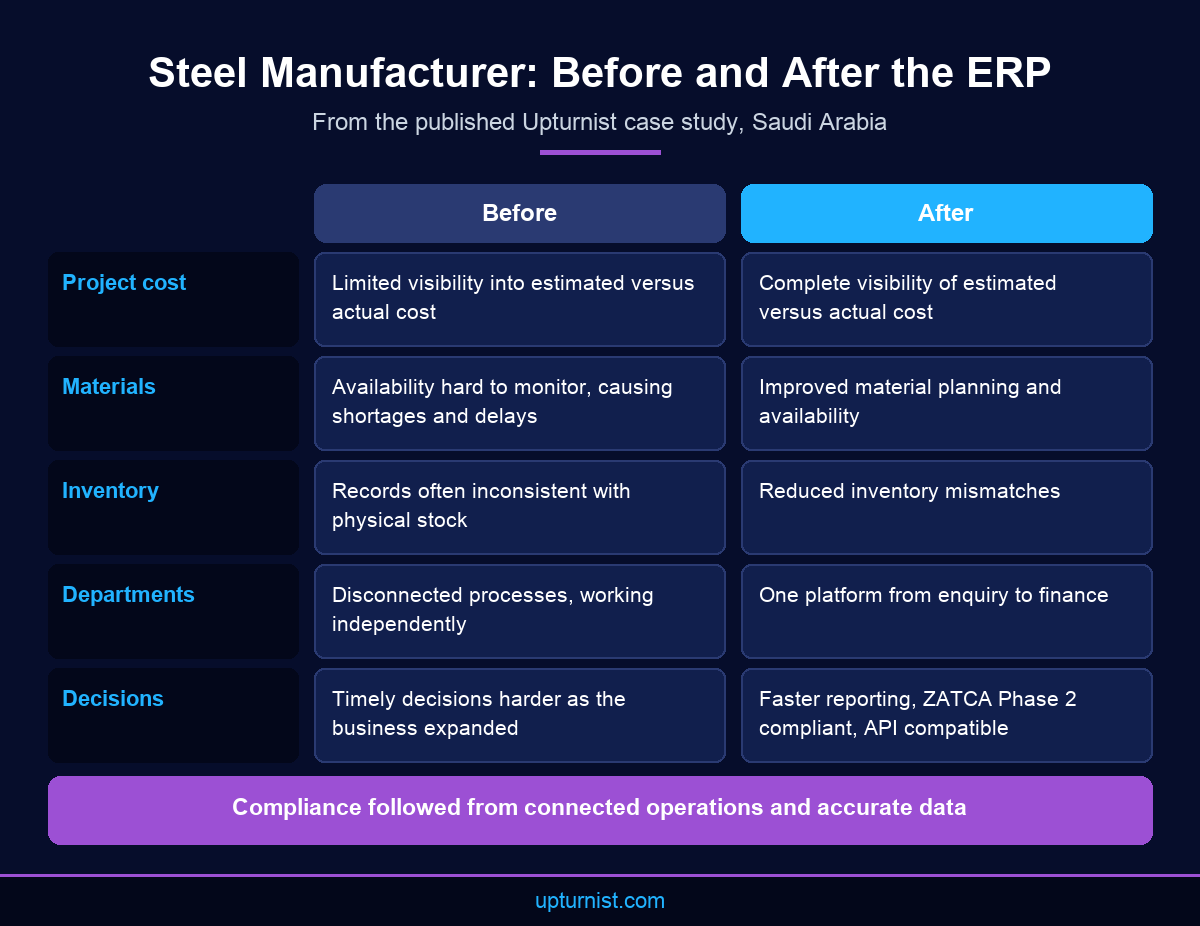
The case study lists the problems clearly. Management had limited visibility into estimated cost versus actual project
cost. Material availability was hard to monitor, which caused shortages and production delays. Inventory records were
often inconsistent with physical stock, leading to planning issues and procurement inefficiencies.
Each of these problems also affects invoicing. If the cost of a job is unclear, the invoice may be late or disputed.
If stock records are wrong, deliveries and invoices drift apart. ZATCA e-invoicing does not create these gaps, but it
exposes them, because every invoice must now be complete and correct the first time.
Steel and fabrication businesses are especially exposed. A single project can involve many materials, partial
deliveries, variations and progress billing. When each step lives in a different file, nobody can be sure the invoice
matches the work done. Strong compliance starts with a reliable record of the job itself, from the first estimate to
the final delivery.
What the ERP Rollout Changed
Upturnist implemented EasyFab ERP, a manufacturing ERP designed specifically for fabrication and industrial
businesses. The solution integrated the full workflow, from enquiry and estimation to procurement, inventory,
production, quality control, delivery and finance. Management gained real time visibility through central dashboards.
The published outcomes include ZATCA Phase 2 compliance and API compatibility. They also include complete visibility
of estimated versus actual project costs, accurate profitability tracking, better material planning and fewer
inventory mismatches. Work orders and production status are monitored in real time.
For anyone searching for a ZATCA Phase 2 compliant ERP for manufacturers, this combination matters. Compliance was not
a separate module bolted on at the end. It came from one platform where every department works from the same accurate
data. That single source of truth is what makes ZATCA e-invoicing reliable at volume.
The project also changed how departments worked together. The case study reports improved coordination between sales,
procurement, production and finance, along with faster management reporting. When these teams share one system, the
invoice becomes the last step of a connected process. It is no longer a separate task in a separate tool, rebuilt by
hand each time.
Five ZATCA E-Invoicing Lessons for UAE Businesses
The UAE model is different. It uses Peppol and Accredited Service Providers rather than direct clearance by the
authority. Yet the operational lessons from ZATCA e-invoicing carry across almost unchanged. Here are the five we see
most often.
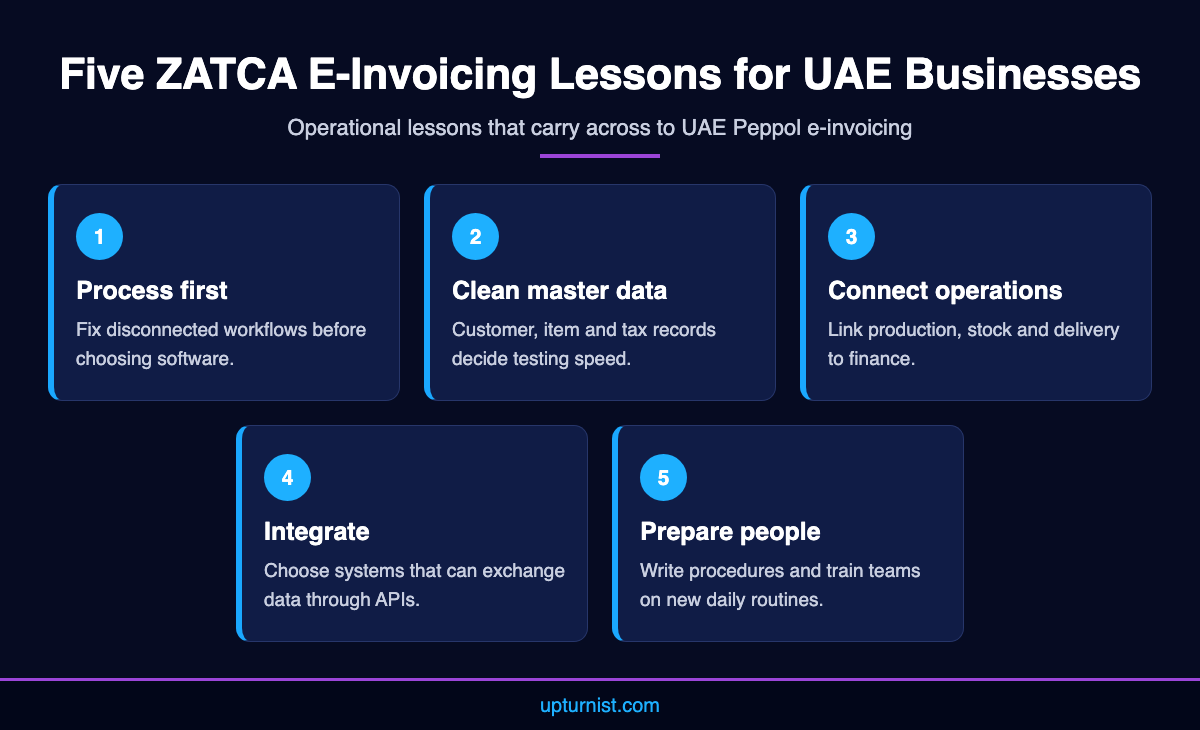
First, fix processes before software. Disconnected workflows produce disconnected invoices. Second, clean master data
early. Customer, item and tax records decide how fast testing goes. Third, connect operations to finance, so invoices
reflect real deliveries and real costs.
Fourth, choose systems that can be integrated. The steel manufacturer’s ERP was API compatible, which matters when an
external platform must receive invoice data. Fifth, plan for people. Corrections, approvals and status checks become
daily routines, and teams need clear procedures and training.
None of these lessons requires waiting for a final technical specification. Process mapping, data clean up and
procedure writing can all start today. They also pay off before go live. Cleaner data and clearer workflows reduce
errors in everyday billing, shorten month end closing and give management numbers they can trust.
These lessons also help when you compare vendors and partners. Ask each one how they would handle your job costing,
partial deliveries and corrections. Ask for examples from your industry. Answers that start with your processes,
rather than with a product demo, usually lead to smoother projects.
Applying the Lessons Before Your UAE Deadline
UAE businesses with revenue of AED 50 million or more must appoint an Accredited Service Provider by 30 October 2026
and go live by 1 January 2027. Smaller businesses follow in 2027. The time to apply these ZATCA e-invoicing lessons is
now, while there is still room to fix data and processes.
Start with an assessment of your current invoicing flow. Map where invoice data comes from and where it breaks. Then
decide whether your ERP can support structured invoices, or whether an upgrade is needed. Our UAE e-invoicing
readiness service covers exactly this work.
Manufacturers have extra steps. Job costing, material issues and partial deliveries all shape the final invoice. An
ERP consultant for steel fabrication companies should understand these flows, not just the tax rules. Our
manufacturing and industrial solutions
connect production, inventory, quality and finance for this reason.
Regulatory advice and system choice also go together. Our ZATCA e-invoicing and
regulatory technology advisory helps businesses
assess readiness, identify gaps and plan ERP integration with minimal disruption.
Finally, set a realistic plan. Count back from your phase date and leave time to test with your Accredited Service
Provider. Teams that test with real invoices find problems while they are still cheap to fix. Teams that test late
often discover data gaps in the same week they must go live.
Conclusion
ZATCA e-invoicing showed Saudi businesses that compliance depends on operations as much as tax rules. In the steel
manufacturer case, integrated workflows, accurate costs and clean inventory came with ZATCA Phase 2 compliance. UAE
businesses face their own deadlines from 2027, under a different model but with the same practical demands. Fix
processes, clean data and choose systems that can be integrated. To plan your next steps,
talk to our consultants about your ERP and invoicing readiness.
Frequently Asked Questions
What is ZATCA e-invoicing?
It is Saudi Arabia’s electronic invoicing system, run by the Zakat, Tax and Customs Authority. Phase One required
compliant electronic invoices from December 2021. Phase Two requires invoicing solutions to integrate with ZATCA’s
systems, rolled out in waves.
When did ZATCA Phase 2 start?
The integration phase began on 1 January 2023. ZATCA rolls it out in waves, so each group of taxpayers receives its
own deadline. Check ZATCA’s official announcements to confirm the timeline that applies to your business.
What is the difference between clearance and reporting under ZATCA?
Standard tax invoices between businesses are cleared by ZATCA before they reach the buyer. Simplified invoices to
consumers are issued first and reported within 24 hours. Both require a compliant, integrated invoicing solution.
Does a manufacturer need a new ERP for ZATCA e-invoicing?
Not always. It depends on whether the current system holds clean, structured data and can be integrated. Disconnected
tools and manual spreadsheets usually need replacing, because compliance relies on accurate data across departments.
Is the UAE e-invoicing model the same as ZATCA?
No. The UAE uses a Peppol based five-corner model with Accredited Service Providers. ZATCA uses direct integration
with its own platform. The operational preparation, such as clean data and connected processes, is very similar.
Which UAE businesses must adopt e-invoicing first?
Businesses with revenue of AED 50 million or more. They must appoint an Accredited Service Provider by 30 October 2026
and go live by 1 January 2027, under Ministerial Decision 244 of 2025 as amended.
What did the steel manufacturer gain beyond compliance?
The published outcomes include visibility of estimated versus actual costs, accurate profitability tracking, better
material planning, fewer inventory mismatches and real time monitoring of work orders and production status.
Coordination between departments also improved.
Has Upturnist delivered ERP projects for engineering companies too?
Yes. Our
engineering company ERP case study
covers digital quality control and live production monitoring for a UAE engineering business. It sits alongside the
Saudi steel manufacturing project and shows a similar connected approach.
Which industries does Upturnist work with?
We work across manufacturing, metal fabrication, construction, oil and gas, engineering and more. See our
industries page for the full list and to see how our solutions are
designed around the processes of each sector.