
Business consulting firms help companies improve how they operate, from strategy and structure to processes and systems. In the UAE, the right choice is rarely the biggest name. It is the partner that understands your operations, fixes the process before buying technology and stays until the change works. This guide explains what business consulting firms do and how to judge them.
It is written for owners and leadership teams in Dubai, Abu Dhabi and across the UAE. It follows the business first approach used at Upturnist: assess the business, improve the process, then implement the right technology. You will also find questions to ask any consultant before you sign.
Key Takeaways
- Good business consulting firms start with how your business runs today, not with a software product or a standard template.
- The safest sequence is business first, process second and technology third, with clear deliverables at each stage.
- Choose a partner that stays through implementation and adoption, because most value is lost between the report and the result.
What Business Consulting Firms Actually Do for Growing Companies
Business consulting firms give leadership teams an outside view of how the company performs and a plan to improve it. The work usually covers strategy, operations, organisation, processes and technology. For a growing company, the real value is focus. A good consultant helps you decide what to fix first, and in what order.
The broad discipline is known as management consulting. It includes services such as process analysis, strategy development, operational improvement and technology implementation. Consultants bring an outside view and specialist expertise. They do not replace your managers, and they do not become part of your organisation.
For small and mid sized UAE businesses, the work is usually practical. Owners want fewer delays, better reporting, clear roles and systems that support growth. They rarely want a long strategy document. The best business consulting firms in this market turn findings into actions your own team can carry out.
Typical deliverables
Most engagements produce a similar set of outputs. Expect an assessment of current operations, a list of issues ranked by impact, a roadmap with owners and timelines, and agreed measures of progress. Some business consulting firms stop there. Others stay to redesign processes, document procedures and implement systems. Ask early which group a firm belongs to, because it changes the price, the timeline and the result. The process improvement consulting offered at Upturnist, for example, includes a strategic assessment report, a growth roadmap and execution support while the plan is delivered.
Who hires a consultant, and when
Owners usually hire consultants at moments of change. Common triggers include rapid growth, a new branch in another emirate, a planned ERP project, a regulatory change or a leadership team that no longer agrees on priorities. In each case, the company needs an independent view before it commits money. If one of these sounds familiar, speak with our consultants about where your operations stand today.
Strategy, Management and Transformation Consulting: How They Differ
Not all business consulting firms do the same work. Most fall into three broad types: strategy, management and transformation. The labels overlap, and many firms offer more than one. What matters is knowing which type of help your problem needs, so you do not pay for a strategy when you need a working process.
Strategy consulting
Strategy consultants answer the question of where to go. They look at markets, services, customers and growth options. The output is usually a plan with priorities and investment choices. Larger business consulting firms often lead with this kind of work. It is useful when leadership is unsure about direction. It is less useful when the direction is clear but daily operations keep getting in the way.
Management consulting
Management consultants focus on how the organisation runs. They review structure, roles, reporting lines, controls and performance measures. Their work often ends with recommendations that leaders then carry out. Many business consulting firms in the UAE sit in this group, offering reviews and advice across functions. The risk is a gap between the advice and the daily work.
Transformation consulting
Transformation consultants change how the business operates and stay to make it stick. Business transformation consulting aligns people, processes and technology. It covers process assessment, process redesign, organisational change, change management and performance management. The difference is ownership of the outcome. A transformation partner is measured by whether teams work differently, not by the quality of the report.
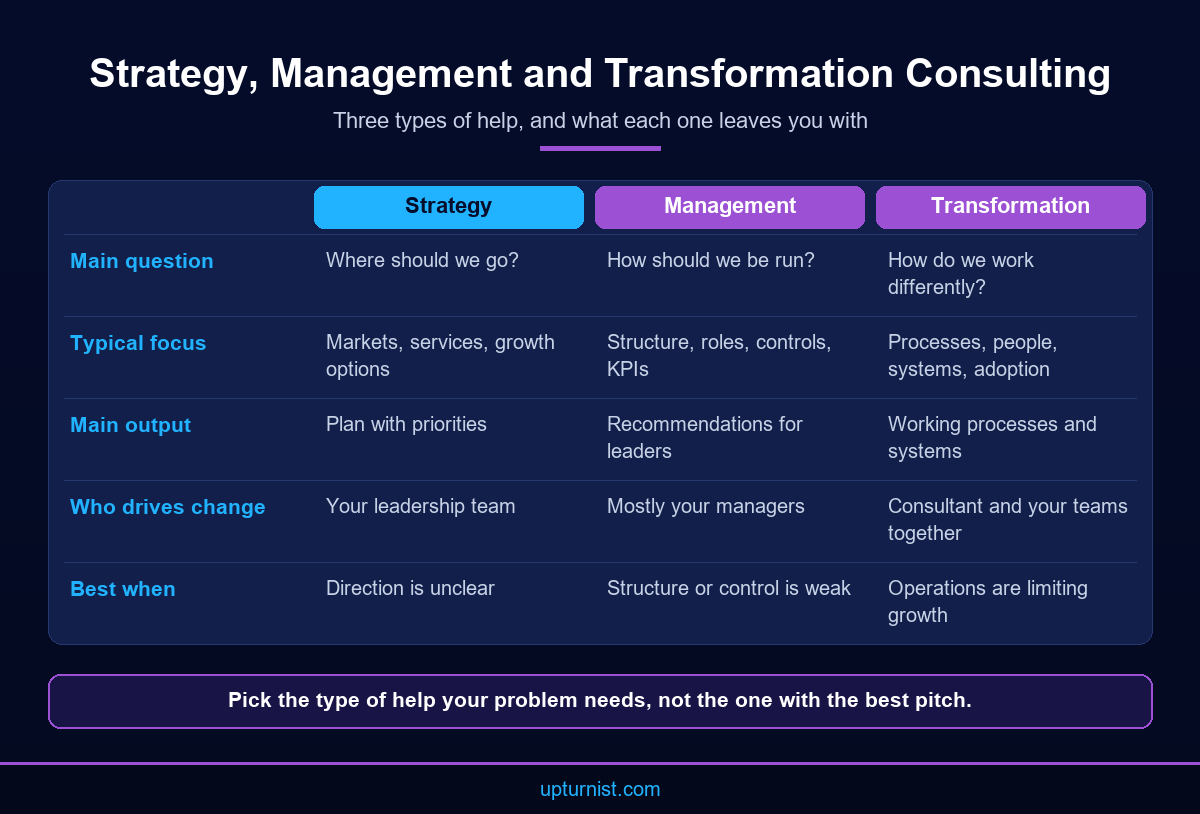
Many companies need a mix. A strategy may show that the business should open in a new emirate. Management advice may then fix the structure. Transformation work then redesigns the processes and systems the new branch will run on. When you compare business consulting firms, ask which of the three they actually deliver themselves.
A proposal usually reveals the type. Strategy work is priced around interviews, market analysis and a final presentation. Management work is priced around reviews and recommendations. Transformation work includes design workshops, process documentation, system configuration, training and a period of support after launch. If those later stages are missing, you are buying advice, however the proposal is titled.
Signs You Need Outside Help: The Six Operational Challenges
Growth should not create operational chaos, yet it often does. As companies grow, teams follow different processes, information scatters across systems and decisions slow down. The Upturnist homepage lists six challenges that signal a business has outgrown its current way of working. If you recognise two or more, it is worth talking to business consulting firms before the problems grow.
1. Processes are not standardised
Each team, branch or manager does the same task differently. Quotes look different, approvals follow different paths and quality varies by site. Customers notice the inconsistency before leaders do. Business consulting firms usually start here, because every later fix depends on one agreed way of working. Our guide on how to write SOPs your teams will follow shows where to begin.
2. Manual work slows down operations
Staff retype data between spreadsheets, chase approvals by email and build reports by hand each month. The work gets done, but slowly and with errors. Manual effort also hides capacity. Your team looks busy, yet much of that time adds no value for the customer. The first step is to see where the time goes. Automation comes later, once the steps worth keeping are clear.
3. Limited visibility into business performance
Leaders wait days or weeks for numbers. By the time a report arrives, the problem has grown. Different departments quote different figures for the same measure. Without one reliable view, decisions rely on instinct and on whoever spoke last in the meeting. The fix starts with agreed definitions for a few key measures, then a single source for each one.
4. Systems that do not communicate
Finance, sales, inventory and projects each run on separate tools. Data is entered twice, and nobody trusts the totals. Adding another system rarely fixes this. Business consulting firms with technology experience can map how data should flow, then decide which tools to connect and which to retire.
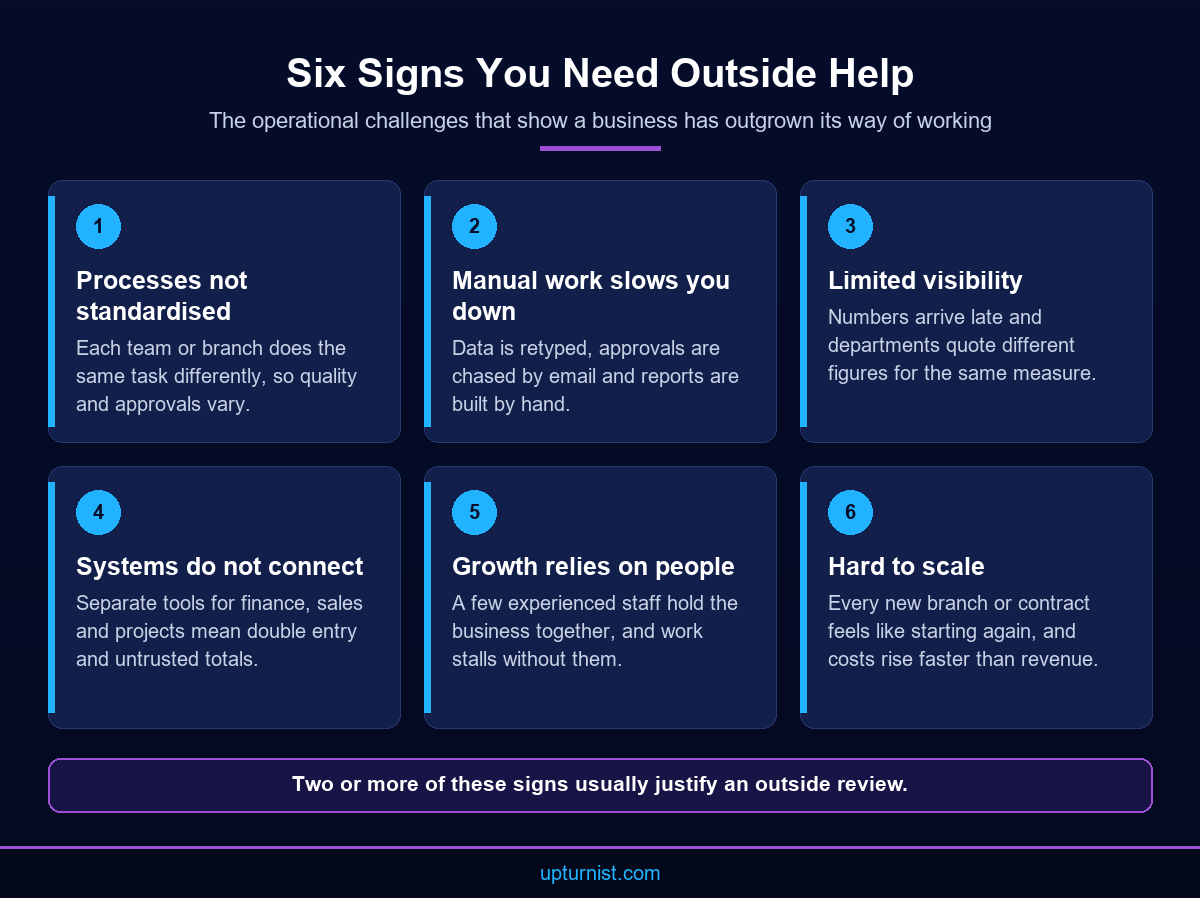
5. Growth depends on individuals
A few experienced people hold the business together. When they are on leave, work stalls. When they leave, knowledge goes with them. This is one of the clearest signs that business consulting firms can help, because the fix is structural: documented processes, clear roles and systems that hold the knowledge.
6. Difficulty scaling operations
Every new branch, product line or large contract feels like starting again. Costs rise faster than revenue, and service quality drops. Scaling needs repeatable processes and systems that work the same way at five sites as at one. The goal is a business that is ready to scale, not one that simply works harder.
Business First, Process Second, Technology Third
The most common mistake in transformation is buying technology to solve a business problem nobody has defined. The better sequence is simple. Understand the business first, improve the process second and implement technology third. Strong business consulting firms follow this order even when the client asks for software on day one.
Why technology comes last
Technology amplifies whatever process it automates. A clear process becomes faster. A confused process becomes faster at producing errors. That is why assessment and process improvement consulting come first. Business consulting firms that skip this step often deliver a new system that repeats old problems. Once the target process is agreed, requirements are clear and the system can be configured around how you work.
Upturnist states the belief plainly: technology alone does not solve business problems. Real transformation happens when strategy, processes and technology work together. That is also why the Upturnist business transformation consultancy is not tied to any software vendor. Every recommendation is based on what suits the business, not on a product to sell.
What the sequence looks like in practice
Take a contracting company that wants a new system because project costs are hard to track. A business first review asks why. It may find that site teams record costs in different ways, approvals happen by phone and nobody owns the cost report. Fixing those points first gives the system clean data and clear rules. Without that work, the new system simply reports the same confusion faster.
A UAE example: e-invoicing
Regulation shows why the sequence matters. The UAE Ministry of Finance has set out an electronic invoicing system in which invoice tax data is reported to the Federal Tax Authority through accredited service providers. Many companies will treat this as a software upgrade. In practice, it also touches invoicing processes, master data and approval controls. A business first review of how invoices are created and approved makes the system change smoother. Our UAE e-invoicing and ERP readiness guide covers the practical steps.
The same logic applies to any major system. ERP, workflow automation and dashboards all work better when the process behind them is agreed first. Technology should support the strategy, not complicate it. If you are about to choose a new system, review the sequence with our consultants before you commit.
Questions to Ask Before You Hire a Consultant
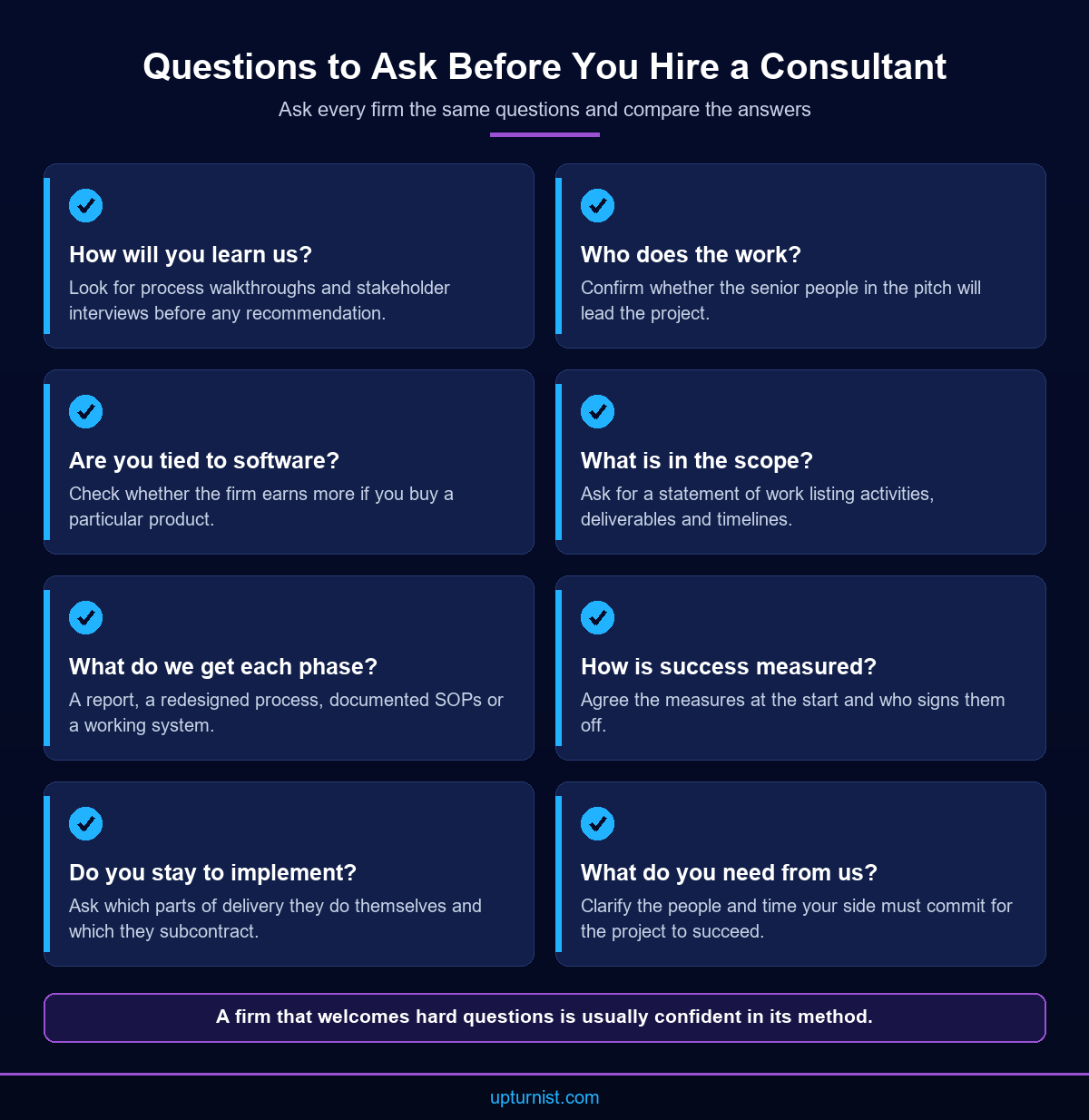
The proposal stage tells you a lot about a firm. Good business consulting firms ask more questions than they answer in the first meeting. Use the questions below to compare proposals on substance, not presentation. Ask the same questions of every firm, and write down the answers.
About their approach
Ask how they will learn your business before recommending anything. Ask who will do the work: the senior people in the pitch, or a junior team. Ask whether they are tied to a software product, and whether they earn more if you buy one. Ask how they handle findings that leaders may not want to hear. Business consulting firms that welcome these questions are usually confident in their method.
About scope and deliverables
Ask for a clear statement of work that lists activities, deliverables and timelines. Vague scopes lead to disputes later. Ask what you will hold at the end of each phase: a report, a redesigned process, documented SOPs or a working system. Ask how changes to scope will be agreed and priced.
About results and evidence
Ask how success will be measured and who agrees the measures. Ask for examples of similar work, and what the client could do afterwards that it could not do before. Ask how the firm supports adoption after go live. Finally, ask what they need from your side, in people and time, for the project to succeed.
Some red flags deserve attention. Be wary of business consulting firms that recommend a specific system before they have seen your processes. Be wary of fixed templates presented as tailored work. Be wary of proposals with no measures, because nobody can then say whether the project worked.
If you already hold a proposal, test it against these questions before you sign. A short delay at this stage costs far less than a project that solves the wrong problem.
Consulting Only vs Consulting Plus Implementation
Some business consulting firms advise and leave. Others advise, then implement and support the change. Both models have a place. The right one depends on your internal capacity, the size of the change and how much risk you can carry if the plan stalls.
Advice only suits companies with strong internal teams. If you have experienced managers, a project lead and spare capacity, a clear roadmap may be all you need. The cost is lower and you keep control. The risk is that the plan waits behind daily work.
Consulting plus implementation suits companies where the change is large or cross functional. ERP projects, multi site process changes and new reporting systems usually fall here. The team that designed the solution configures it, trains users and fixes issues after go live. Nothing is lost in a handover between advisers and implementers.
A hybrid model also works. Some companies hire a consultant for the assessment and design, then run delivery themselves with periodic reviews. This keeps costs down while protecting the design. It only works if your team has the time, and if the consultant is accountable for checking progress against the plan.
Adoption is often the deciding factor. Change management is the discipline of preparing and supporting individuals, teams and leaders through organisational change. It matters most when processes, systems or technology are being updated. An implementation focused partner plans training, communication and feedback as part of delivery, not as an afterthought. This is where business transformation consulting earns its fee.
Where implementation means new systems, check the firm’s range. Our digital transformation services cover ERP implementation, process automation, dashboards and systems integration. Each one should connect directly to the process work that came before it. Where the question is which system to choose, independent technology consulting protects you from paying for software you do not need.
Ask business consulting firms which parts of delivery they do themselves and which they subcontract. A firm that hands your project to a third party after the design stage is offering advice only, whatever the proposal says.
What a First 90 Days Should Deliver
A good engagement shows value early. You should not wait a year to know whether a partner is right. The first 90 days will not finish a transformation, but they should give you a clear baseline, agreed priorities and at least one visible improvement. Use the stages below as a guide when you review business consulting firms and their proposed plans.
Days 1 to 30: understand
The consultant walks through your processes with the people who run them. They interview leaders, review reports and tools, and collect the forms and spreadsheets in use. Business consulting firms that skip the site walk and work only from interviews tend to miss how work really happens. By the end of the month you should see a current state picture and a ranked list of issues.
Days 31 to 60: define and design
The team agrees the outcomes that matter and the measures that will show progress. Target processes are designed with the managers who will run them. Requirements for any system are written from those processes. Priorities, owners and timelines go into a roadmap that leadership signs off. If leaders cannot agree on the roadmap, that disagreement is itself a finding worth resolving before any spending starts.
Days 61 to 90: first results
At least one priority should move from paper to practice. That may be a redesigned approval flow, a set of documented procedures or a first dashboard. Our SOP development service is often part of this stage, because new ways of working need to be written down. The measures agreed in month two should now be tracked.
Measures need care. A key performance indicator evaluates how well an organisation, activity or process achieves defined objectives. Pick a few that link directly to the problems found in month one. Business consulting firms that cannot name the measures by day 60 are unlikely to deliver results you can see.
How Upturnist Works: Understand, Define, Design, Implement, Sustain
Upturnist follows five stages on every engagement: Understand, Define, Design, Implement and Sustain. The stages put business first, process second and technology third. They can run as one project or in phases, depending on where your business is today. Our full range of services is designed to be used on its own or combined.
- Understand: stakeholder discussions, process walkthroughs and a review of the tools and reports you use today.
- Define: agree the problems worth solving, the outcomes that matter and the measures that will show progress.
- Design: design processes, controls and system requirements around your operations, not a generic template.
- Implement: configure and deliver the solution with your teams, including training and handover.
- Sustain: monitor results through KPIs and management reporting, so improvements last beyond the project.
The point of the sequence is continuity. The team that assesses the business stays through implementation and adoption, so nothing is lost between advice and delivery. Whichever business consulting firms you shortlist, insist on that kind of continuity.
Each stage also has a clear output. Understand produces a current state picture. Define produces agreed outcomes and measures. Design produces target processes and system requirements. Implement produces a working solution that trained users run every day. Sustain produces regular reviews, so results hold after the project team steps back.
Industry context shapes each stage. Our page on the industries we support shows how solutions are designed around manufacturing, construction, oil and gas, government and other sectors. A fabrication workshop and a municipality need very different systems. For platforms already running in live operations, such as field operations automation, see our solutions overview.
Conclusion
Choosing between business consulting firms in the UAE comes down to fit, sequence and follow through. Look for a partner that studies your operations first, fixes the process before buying technology and stays until teams work differently. Ask hard questions about scope, measures and adoption, and expect visible progress within the first 90 days. Upturnist works this way, business first and implementation focused. The aim is simple: improve the way you operate and build a business that is ready to scale. If you want an honest view of where to start, book a conversation with our consultants.
Frequently Asked Questions
What do business consulting firms do?
They help companies improve how they operate. Typical work covers assessing current operations, setting priorities, redesigning processes, defining roles and measures, and sometimes implementing systems. The best firms turn findings into a practical roadmap that managers can own and carry out.
How do I choose a business consultant in the UAE?
Check how they learn your business before recommending anything, who will do the work and whether they are tied to a software product. Ask for clear deliverables, agreed measures and examples of similar work. Prefer partners who stay through implementation.
What is the difference between business consulting and business transformation?
Business consulting usually sets direction through assessment, strategy and recommendations. Business transformation changes how the company operates by redesigning processes, aligning roles, managing change and building performance reporting. Many companies need both, starting with an assessment and then moving into transformation.
When should a company hire a consultant?
Common signs include processes that differ between teams, heavy manual work, slow or unreliable reporting, systems that do not connect, growth that depends on a few people and difficulty scaling. Two or more of these usually justify an outside review.
Should we choose technology before hiring a consultant?
Usually not. Technology works best once the business problem and the target process are clear. Choosing software first often locks in old habits. Start with an assessment, agree the process, then select technology that fits how you want to work.
How long does a consulting engagement take?
It depends on scope. A business assessment or SOP project is usually shorter than an ERP or platform implementation. A good partner agrees phases and milestones at the start, so you know exactly what will be delivered and when.
Does Upturnist only advise, or does it also implement?
Both. Upturnist combines business consulting, process improvement and technology implementation. The same team assesses operations, designs processes and delivers systems with your staff, including training and handover, then reviews results through KPIs and management reporting.
Can we start with one service and add more later?
Yes. Many companies begin with a business assessment or a single process, then extend into digital transformation or technology consulting once early results are clear. Each stage should connect to the next, so earlier work is never wasted.
Where can I see examples of transformation projects?
Upturnist publishes anonymised examples across oil and gas, government, manufacturing, engineering and construction. Browse our project case studies to see the challenge, the solution and the business outcomes in each project, from HSE inspections to ERP implementations.