
A business setup consultant who works on operations helps a new company decide how it will run, not only how it will register. Many founders in the UAE spend their first months on licences and approvals, then find the business itself has no clear structure, procedures or systems.
At Upturnist, we treat that operational setup as the real foundation of a new business. This guide explains what an operations focused engagement covers, from structure and SOPs to reporting basics and technology readiness. It also explains which part stays a separate licensing step, handled with the relevant authority.
Key Takeaways
- A trade licence lets you operate. It does not tell your team how to operate, who decides what or which systems to use.
- A business setup consultant with an operations focus covers structure, core processes, SOPs, reporting basics and technology readiness.
- Getting these right early is cheaper than fixing them after the team, the customer base and the systems have grown.
The Licence Is One Step, Not the Whole Setup
Registering a company and setting up how it works are two different jobs. Licensing, approvals and company formation are handled with the relevant authority and are a separate step. An operations focused business setup consultant starts where that step ends. The focus moves to people, processes and systems, so the business can serve its first customers with control.
The official UAE Government portal sets out the steps to start, run and close a business on the mainland. Use it, or the authority for your chosen jurisdiction, for the legal side. This article does not cover licensing.
What it does cover is the gap that opens after the licence arrives. The first hires join. The first orders come in. Quotes, purchases and payments are handled by whoever is free. It works while the team is small, but growth soon depends on individuals instead of systems.
Growth that depends on people rather than systems is one of the most common operational challenges for young UAE businesses. A business setup consultant with an operations focus closes it before it becomes expensive. If you are at this stage now, speak with our consultants about where your gaps are.
What Operational Setup Covers
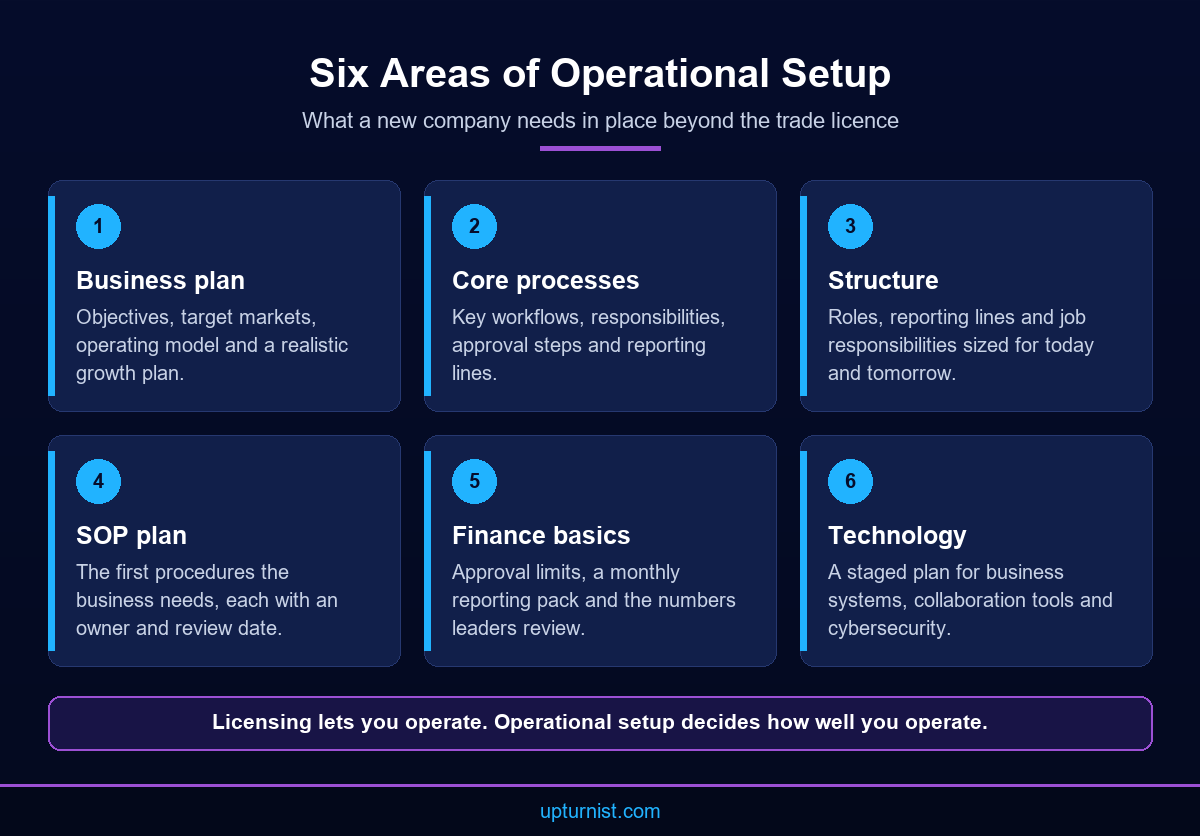
Operational setup is the work a business setup consultant does to decide how the business will run from day one. It covers the business plan and model, the core processes, the organisation structure and SOPs, the finance and reporting basics, and the technology the company will rely on. Each area needs a clear owner and a simple first version.
A good engagement produces working tools, not a thick report. Expect these outputs:
- Business plan and model. Objectives, target markets, the operating model and a realistic growth plan.
- Core process design. The key workflows, departmental responsibilities, approval steps and reporting lines.
- Organisation structure. Roles, reporting lines and job responsibilities, sized for today with room to grow.
- SOP plan. A list of the procedures the business needs first, with an owner for each.
- Finance and reporting basics. Approval limits, a monthly reporting pack and the few numbers leadership will review.
- Technology readiness. A plan for business systems, collaboration tools and basic cybersecurity practices.
This is the scope of our setup work. We act as a business consultant for startups, investors and new entities, with one aim: a company that is operationally ready and ready to scale.
Design the Core Processes Before the First Customer
Every new business runs on a handful of processes. Typical examples are quote to cash, purchase to pay, hire to onboard and service delivery. Design each one simply before volume arrives. Name the steps, the owner and the approvals, and agree where records will be kept. Small, clear processes are far easier to grow than habits formed under pressure.
Start with the process that touches customers or cash first. Draw it on one page with a lane for each role. Mark every approval and every handoff. Then ask whether each step is needed, and remove the ones that are not.
A business setup consultant can facilitate this quickly, because the questions are standard even when the business is not. Who can approve a discount? Who signs off a purchase? Where does a customer complaint go? Answering them once, in writing, saves many arguments later.
A business consultant for startups should also keep the design light. A five person company needs clear steps, not a manual. Add detail only when volume, risk or audits demand it.
Once the core processes are agreed, a business setup consultant should check them against the business plan. Do they support the markets, services and volumes you expect in the first year? If not, adjust them now. If you would like help mapping yours, talk through your setup plan with us.
Structure, Roles and SOPs From Day One
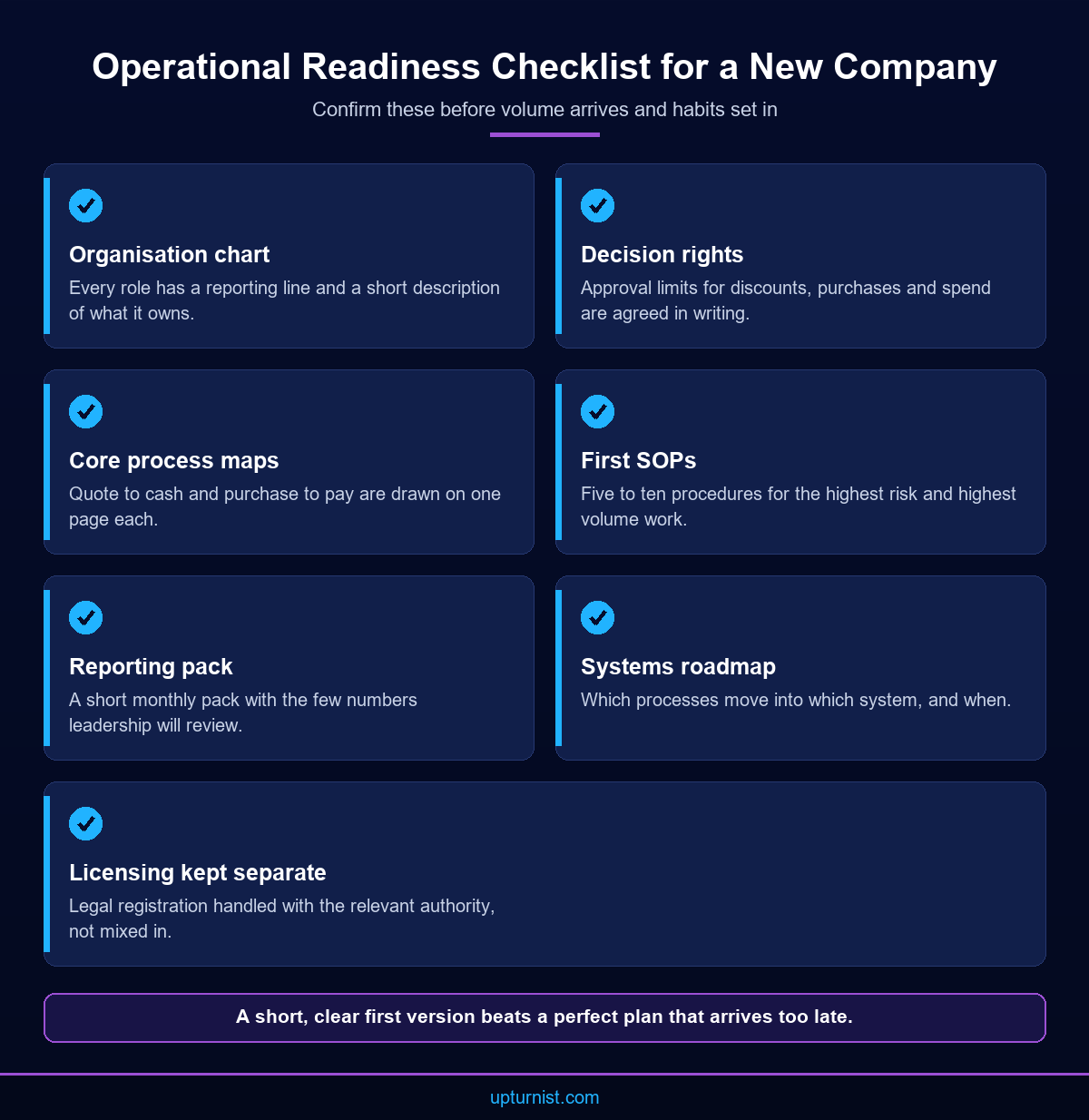
A clear structure tells every person what they own and who they report to. Draw a simple organisation chart, write short role descriptions and agree decision rights. Then document the most important processes as SOPs. Together, these reduce dependence on any one person and make onboarding much faster as the team grows.
Keep role descriptions short. Each one needs a purpose, the main responsibilities, the decisions the role can make and the measures it is judged on. Review them when the business adds a new team or location.
SOPs turn the process design into daily practice. Write the first procedures for the processes that carry the most risk or the most volume. Our SOP development service covers department procedures, digital SOP management and regular reviews.
You do not need every procedure in month one. Start with five to ten, written in plain language, with an owner and a review date. For a practical method, see our guide on how to write SOPs your team will use.
A business setup consultant should leave you with a short SOP list and a plan for the rest. That way, documentation grows with the business instead of lagging behind it.
Finance, Reporting and Technology Readiness
The finance and technology choices made in year one shape the business for years. Set approval limits, a simple monthly reporting pack and a short list of numbers leadership will review. Then plan the business systems before growth forces a rushed choice. Planning technology early reduces later implementation costs and disruption.
On the finance side, keep the basics tight. Agree who can commit spend and up to what amount. Decide how invoices, purchases and expenses are approved and recorded. Work with your accountant on registrations and filing, which sit outside operational setup.
On the technology side, a business setup consultant should help you think in stages. A new company rarely needs a full ERP on day one. It does need a plan for which processes will move into which system, and when. Our technology consulting team helps businesses assess requirements, choose suitable systems and plan integration.
Smaller companies should also look at public support. The UAE Government portal lists programmes that support SMEs, including the National SME Programme, Khalifa Fund and Dubai SME.
Finally, plan for growth. A business setup consultant should help you set out what changes when you add a branch, a product line or a second shift. Scalable processes, a performance framework and a technology roadmap let the business expand without losing control.
How to Choose a Business Setup Consultant for Operations
Not every business setup consultant works on operations. Many focus on registration, which is a different service. Before you hire anyone for operational setup, ask what they will deliver, who will do the work and how long they will stay involved. The answers show quickly whether you will get working tools or a report.
Useful questions to ask any business consultant for startups include:
- What will we have in hand at the end, such as process maps, an organisation chart, SOPs and a reporting pack?
- Who will run the workshops, and how much time will our own team need to give?
- How will you support us after the plan is written, during the first months of operation?
- How do you decide which systems we need, and in what order?
Clear answers in plain language are a good sign. So is a partner who keeps licensing questions separate and points you to the relevant authority for them.
Conclusion
A trade licence is only the start. A business setup consultant who focuses on operations helps you design the structure, processes, SOPs, reporting and systems that let the company run without chaos. Treat licensing as a separate step with the relevant authority, and give operational setup the same attention. At Upturnist, we help founders and investors build businesses that are operationally ready from the first day. The work stays business first and implementation focused, so the plan turns into daily practice. If you are planning a new company or entity, book a conversation with our consultants.
Frequently Asked Questions
What does a business setup consultant do beyond licensing?
An operations focused consultant designs how the new company will run. That includes the business plan, core processes, organisation structure, SOPs, finance and reporting basics, and technology readiness. Licensing itself is a separate step handled with the relevant authority.
Does Upturnist handle trade licences or company formation?
No. Our work covers operational setup only: processes, structure, SOPs and systems. Licensing and company formation are handled separately with the relevant authority. Upturnist then helps the new business become operationally ready and prepared to grow.
When should a startup start operational setup?
Ideally before the first hires and customers arrive, or as soon as possible afterwards. Designing processes and roles early is easier than untangling habits that formed under pressure. Even a few weeks of planning before launch pays off.
What are the first processes a new company should design?
Start with the processes that touch customers or cash. Quote to cash, purchase to pay, hire to onboard and service delivery are typical. Each needs clear steps, an owner, approval rules and an agreed place to keep records.
How many SOPs does a new business need?
Fewer than most founders expect. Five to ten procedures for the highest risk and highest volume processes are a good start. Add more as the team, the customer base and the number of locations grow, and review each one regularly.
Does a startup need an ERP from day one?
Usually not. A new company needs a clear plan for which processes will move into which systems, and when. Choosing systems in stages avoids paying for features too early while still preventing a rushed decision once growth arrives.
What should a business consultant for startups deliver?
Practical tools rather than a long report. Expect a business plan, process maps, an organisation chart with role descriptions, an SOP list, a reporting pack and a technology roadmap. Each output should have an owner and a review date.
Is operational setup only for brand new companies?
No. Investors opening a new entity, companies adding a branch and young businesses that grew quickly all benefit. Our business consulting service also helps established firms review strategy, structure and processes before a period of growth.
How do I choose an operations focused setup partner?
Ask what they deliver, who does the work and how they stay involved after the plan is written. Look for practical outputs, plain language and implementation support. Check that they keep licensing advice separate and refer it to the relevant authority.