
Peppol e-invoicing is coming to every UAE business that sells to other businesses or to government. Under Peppol e-invoicing, an invoice is no longer a PDF sent by email. It becomes structured data that moves through accredited providers and reaches the Federal Tax Authority in near real time. Most guides explain the tax rules. This guide looks at the other side: your ERP, your master data and your processes. You will learn who must comply and when, how the five-corner model works, and what to fix inside your systems first.
Key Takeaways
- Large businesses with revenue of AED 50 million or more must appoint an Accredited Service Provider by 30 October 2026 and go live with Peppol e-invoicing by 1 January 2027.
- The hardest work is inside the ERP: clean master data, complete tax fields, correct credit notes and a reliable connection to your provider.
- Choosing e-invoicing solutions is easier once each department knows what it must change, so plan readiness by function, not only by system.
What Peppol E-Invoicing Means for UAE Businesses
The UAE is replacing paper and PDF invoices with structured electronic invoices for business transactions. The rules sit in Ministerial Decision No. 243 of 2025, which defines an electronic invoice as one issued, transmitted and received in a structured format that allows automatic processing. A scanned document or an emailed PDF does not meet that definition.
The country chose the OpenPeppol framework as its base. Peppol is an international network and set of specifications for exchanging business documents. Its main benefit is interoperability. A supplier and a buyer can use different software and still exchange invoices, because both connect through certified access points that speak the same language. The Ministry of Finance notes that this standard also opens a wider network for exchanging invoices with businesses outside the UAE.
Peppol e-invoicing in the UAE adds one important layer. Every invoice also produces tax data that is reported to the Federal Tax Authority. So the system does two jobs at once. It delivers the invoice to the buyer, and it reports the tax data to the government. This model is called Decentralised Continuous Transaction Control and Exchange, or DCTCE.
For a business, the change is more than a new file format. Peppol e-invoicing touches how customers are set up, how prices and taxes are calculated, how corrections are handled and how records are stored. That is why the work belongs to operations and IT as much as to the tax team. If your invoices come out of an ERP, the ERP is where most of the preparation happens.
The change affects both sides of your business at once. When your customers go live, they will expect Peppol e-invoicing documents from you. When your suppliers go live, your accounts payable team will receive structured invoices instead of PDFs. Businesses that prepare early can also remove manual steps. Structured data can flow straight into approvals, matching and payment runs. The Ministry of Finance points to faster invoice cycles, fewer errors and better cash flow as benefits. Those benefits appear only when the data inside your systems is reliable.
The scope is broad. Decision 243 applies to any person conducting business in the UAE for every business transaction, unless an exclusion applies. Business to consumer sales are outside the system for now, until the Minister issues a decision that brings them in. The exclusions cover a short list of activities, such as certain airline services and exempt or zero rated financial services.
The Five-Corner Model in Plain Language
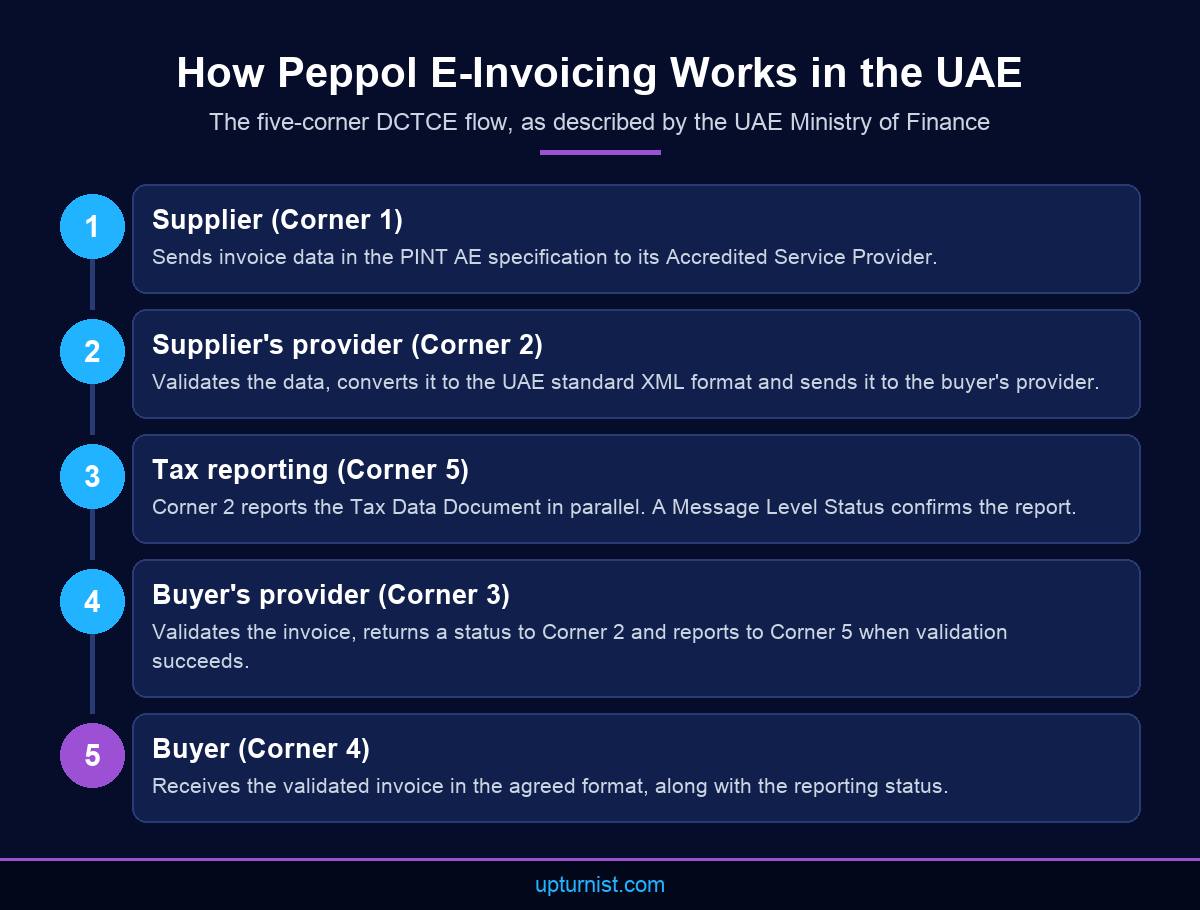
Peppol e-invoicing in the UAE runs on a five-corner model. Each corner is a party with a defined role. Understanding the corners helps you see which parts your ERP must handle and which parts your provider will handle for you. The Ministry of Finance describes the full flow on its eInvoicing portal.
The Five Corners
Corner 1 is the supplier issuing the invoice. Corner 2 is the supplier’s Accredited Service Provider. Corner 3 is the buyer’s Accredited Service Provider. Corner 4 is the buyer. Corner 5 receives the Tax Data Document, which is the tax reporting side of the system run for the Federal Tax Authority. The supplier and buyer never connect to each other directly. They connect only to their own providers.
How an Invoice Moves
The supplier sends invoice data in the PINT AE specification to its provider. The provider validates it and converts it into the UAE standard XML format if needed. It then sends the invoice to the buyer’s provider and, in parallel, reports the Tax Data Document to Corner 5. The buyer’s provider validates the invoice and returns a Message Level Status. If validation succeeds, it also reports to Corner 5 and passes the invoice to the buyer.
What This Means for Your ERP
Your ERP owns Corner 1. It must produce complete, valid invoice data every time, and it must read the status messages that come back. A rejected invoice is not a delivered invoice. If your ERP cannot capture and act on those messages, your team will not know which invoices failed until a customer or the authority asks.
Peppol e-invoicing also changes the buyer side of your ERP. Decision 243 requires recipients to process electronic invoices through the system. Incoming invoices arrive as structured data through your provider. Your payables process should import them, match them to purchase orders and goods receipts, and route exceptions for approval. Teams that still key supplier invoices by hand will feel this change quickly, so review matching rules and approval limits now.
Validation failures will happen, especially in the first weeks. A missing identifier, a wrong tax category or a rounding difference can stop an invoice. Decide now who receives each rejection, how fast it must be fixed and how the corrected invoice is resent. A short daily review of rejected and pending invoices keeps problems small and protects your cash flow.
Who Must Comply With Peppol E-Invoicing and When
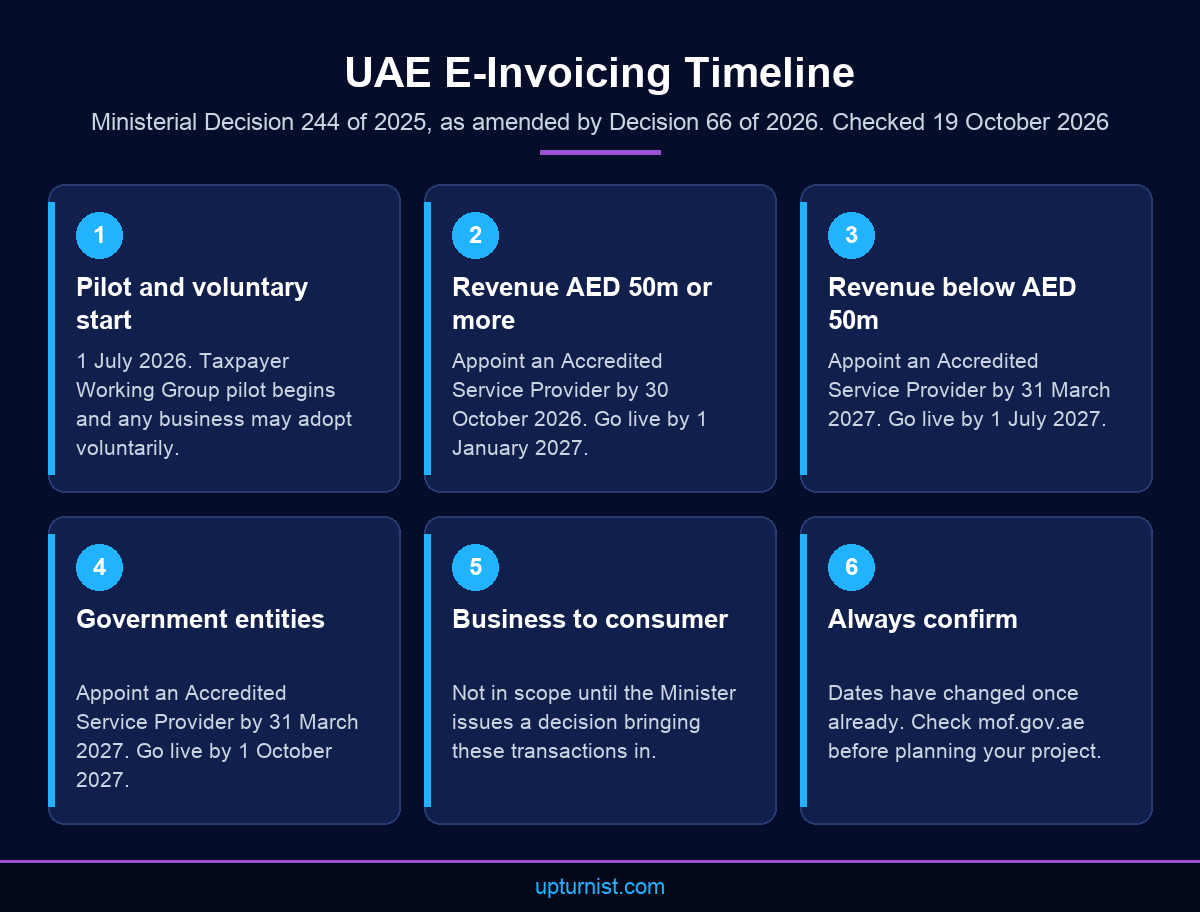
The timeline is set by Ministerial Decision No. 244 of 2025. Its first deadline was changed by Ministerial Decision No. 66 of 2026. The phases depend on revenue, which the decision defines as gross income in your most recent accounting period, based on your financial statements. The dates below were checked against the Ministry of Finance documents on 19 October 2026.
Businesses With Revenue of AED 50 Million or More
These businesses must appoint an Accredited Service Provider by 30 October 2026. They must implement Peppol e-invoicing by 1 January 2027. The original appointment deadline was 31 July 2026. Decision 66 of 2026 moved it, but it kept the January go live date unchanged. For many large groups, the gap between appointment and go live is only two months.
Businesses Below AED 50 Million and Government Entities
Businesses with revenue below AED 50 million must appoint a provider by 31 March 2027 and implement by 1 July 2027. Government entities must appoint a provider by 31 March 2027 and implement by 1 October 2027. After these phases, anyone subject to the system must appoint a provider and implement it.
Pilot and Voluntary Adoption
A pilot programme with a Taxpayer Working Group began on 1 July 2026. Any business can also adopt the system voluntarily from that date. Early adopters must follow all the technical requirements. Dates can change, so confirm them on the Ministry of Finance site before you plan your project.
Two further points help with planning. Businesses outside the scope may still join voluntarily, but they must then follow all the rules except those on violations and penalties. Penalties for breaches are set separately in Cabinet Decision No. 106 of 2025. The safest approach is to treat your Peppol e-invoicing phase date as fixed and finish testing well before it. Groups should check revenue for each legal entity, because entities can fall into different phases.
What Changes Inside Your ERP
Most businesses already issue invoices from an ERP or accounting system. The question is whether that system can produce Peppol e-invoicing data that passes validation, every time, at volume. In practice, the gaps show up in four places.
Industry and custom ERPs need extra care. Systems built for fabrication, contracting or rental often store prices, taxes and customer details in their own structures. A standard connector may not read them correctly. In these cases, fields may need code changes rather than simple settings. Plan time for that work early, because it usually sits on the critical path to go live.
Master Data
Customer and supplier records are the foundation. Each trading partner needs complete legal names, tax registration details and the identifiers used to reach them on the network. Duplicate customers, missing tax numbers and free text addresses all cause rejections. Cleaning master data is slow, so it should start before any software work.
Invoice and Tax Fields
Decision 243 says the Ministry prescribes the data fields every electronic invoice must carry. Your ERP must hold each field in a structured way, not inside a notes box. Item descriptions, units, tax categories and amounts must be calculated consistently. Custom fields added over the years often need to be mapped or rebuilt.
Credit Notes and Corrections
An electronic credit note is required when a transaction is cancelled, when the agreed price is reduced, when consideration is returned, or when an administrative or numerical error occurs. Many teams fix errors by cancelling and reissuing quietly. Under Peppol e-invoicing, each correction must follow a controlled credit note process.
Timing, Storage and Failures
Decision 243 requires an electronic invoice to be issued and transmitted within 14 days from the date of the business transaction, subject to VAT timelines for registrants. Invoice data must be stored within the UAE. A system failure must be reported to the authority within two business days. Your processes need owners for each of these rules.
A simple test reveals the size of the gap. Take a sample of last month’s invoices and try to fill every required Peppol e-invoicing field from the ERP alone, without spreadsheets or manual notes. Every field you cannot fill is a work item. Every value that differs between systems is a data quality issue. This exercise takes days, not months. It gives your project a realistic scope before you commit to a provider or a budget.
Accredited Service Providers and Your ERP
You cannot send Peppol e-invoicing documents directly to the authority. Decision 243 requires both the issuer and the recipient to fulfil their obligations through an Accredited Service Provider. The Ministry publishes the list of accredited providers, and its portal sets out considerations for selecting one.
The provider and the ERP must work as one chain. The provider handles validation, conversion, network exchange and reporting. The ERP handles the data and the business response. If the link between them is weak, invoices stall in the middle. That is why integration design matters as much as the provider choice.
Start with a few practical questions. How will invoices leave the ERP: through an API, a connector or a file exchange? How will status messages return to the right record? Who sees rejected invoices, and how fast can they fix them? Can the provider receive invoices from your suppliers as well as send yours? Clear answers make it easier to compare e invoicing solutions on substance rather than on price alone.
Our technology consulting team helps businesses evaluate options against their own processes. We are not tied to any software vendor, so the aim is a provider and integration design that fit the way your business already works.
Contract terms deserve attention too. Ask how the provider handles onboarding, test environments, support hours and service levels. Ask how it will notify you of rejected invoices and outages. Confirm where data is stored, because Decision 243 requires electronic invoice data to be kept within the UAE. A provider that fits your volumes, formats and support needs saves effort for years. A poor fit creates manual work every day.
Lessons From ZATCA Phase 2 in Saudi Arabia
Saudi Arabia started its own journey earlier. The Zakat, Tax and Customs Authority enforced its generation phase from 4 December 2021 and began its integration phase on 1 January 2023, rolling it out in waves. The model differs from the UAE design, but the operational lessons carry across.
Upturnist has implemented ZATCA Phase 2 compliant solutions for clients in Saudi Arabia. One published example is an ERP implementation for a steel manufacturer. Before the project, the company relied on disconnected processes. Tracking actual costs, material consumption and inventory was difficult. The ERP connected estimation, procurement, inventory, production, quality, delivery and finance on one platform, and the outcomes included ZATCA Phase 2 compliance.
Phase 2 in Saudi Arabia also showed how much depends on the invoicing system itself. Under ZATCA rules, the electronic solution must be integrated with the authority’s systems, and invoices must follow a required format. Businesses with older or heavily customised software may find that compliance means upgrading the ERP, not just adding a plugin. UAE businesses with similar systems should check this early, while there is still time to choose.
The first lesson is that compliance sits on top of operations. When sales, stock and finance live in separate tools, the invoice inherits every inconsistency. The second lesson is that data quality decides the timeline. Clean customer and item records shorten testing more than any other single task. The third lesson is that people need new habits. Corrections, approvals and status checks become daily routines, not month end clean ups.
These lessons apply directly to Peppol e-invoicing in the UAE. Treat it as an operations project with a tax deadline, not a tax project with an IT task attached.
There is also a lesson about timing. ZATCA rolled out its integration phase in waves, and each wave had a fixed window to connect. Teams that waited often had to rush data clean up and testing together. The UAE Peppol e-invoicing timeline works in a similar way. Once your phase date is clear, count back from it. Then set dates for data clean up, integration build, testing and training.
A Peppol E-Invoicing Readiness Plan by Department
Readiness is easier to manage when each department owns a clear list. The plan below is a practical starting point for most ERP run businesses. Adjust it to your structure and your phase.
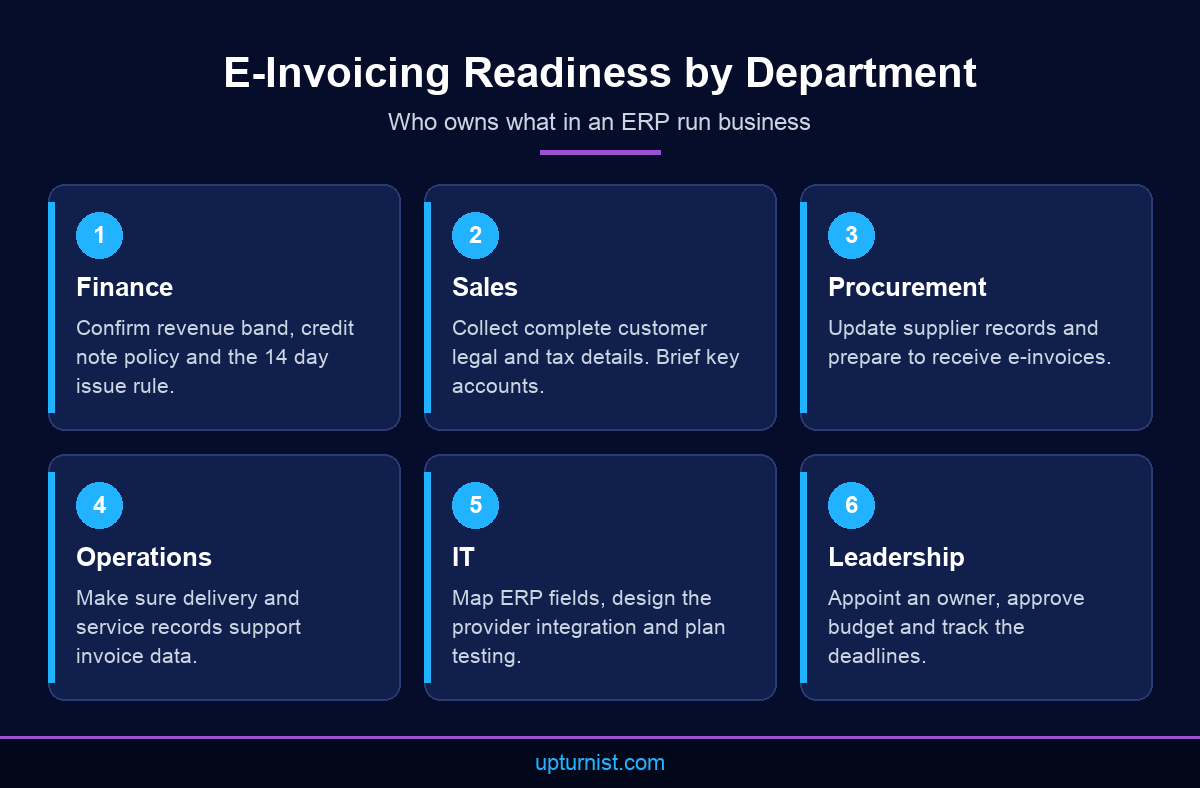
Finance should confirm revenue for the most recent accounting period, because it decides the phase. It should also review credit note policies and invoice timing against the 14 day rule. Sales and customer service should collect missing customer details and explain the change to key accounts.
Procurement should do the same for suppliers, because your business will also receive electronic invoices. Operations should check that delivery and service records support the invoice data. IT should map ERP fields, design the provider integration and plan testing. Leadership should appoint an owner, approve the budget and track the deadline.
Written procedures help each team keep the new routines. Our SOP development service documents processes such as credit note approval and rejection handling, so the rules survive staff changes.
Run the plan as one project with a weekly review. A simple tracker listing each task, owner, deadline and status keeps everyone aligned. Include a test window where real invoices pass through the provider’s test environment before go live. Use the results to fix data and process gaps, not to blame teams. Peppol e-invoicing readiness is shared work. Departments that see their own tasks clearly usually finish on time, and a clear Peppol e-invoicing plan keeps leadership informed.
Training is the final step and often the most overlooked. Billing staff need to know how to read status messages and correct rejections. Payables staff need to know how to review incoming structured invoices. Managers need simple reports that show volumes, rejections and open issues. Short, role based sessions close to go live work better than one long briefing months before it.
Where Upturnist Helps
Upturnist is a UAE based business transformation consultancy. We support Peppol e-invoicing readiness from the ERP and operations side. We assess existing systems, optimise invoicing processes and prepare ERP platforms for compliance. Our regional experience comes from ZATCA Phase 2 work in Saudi Arabia.
Where the gap is wider than invoicing, we look at the whole system. Our enterprise digital transformation work covers ERP implementation, workflow automation and integration. For manufacturers and fabricators, our manufacturing and industrial solutions connect production, inventory, quality and finance, so the invoice is built on accurate job data.
Many firms search for an e-invoicing readiness consultant for ERP systems only when a deadline is close. Starting early leaves time to clean data, test with your provider and train your teams properly.
Every engagement follows the same approach. We understand your business first, improve the way it works, and then implement the right solutions. For Peppol e-invoicing, that means a readiness assessment of systems and processes, and a prioritised list of fixes. It also means support with integration and testing, and team training before go live. After go live, we help you review results and keep improving.
Conclusion
Peppol e-invoicing changes how every UAE business invoice is created, delivered and reported. The deadlines are fixed in ministerial decisions, and the first one arrives on 30 October 2026 for large businesses. The real work sits in your ERP: master data, invoice fields, credit notes and the link to your provider. Start with a readiness assessment, assign owners by department and test early. If you want a practical plan for your systems, talk to our consultants about your e-invoicing readiness.
Frequently Asked Questions
What is Peppol e-invoicing in the UAE?
It is the UAE system for exchanging structured electronic invoices through Accredited Service Providers. It is based on OpenPeppol. Each invoice is delivered to the buyer and its tax data is reported for the Federal Tax Authority.
When does e-invoicing become mandatory in the UAE?
Businesses with revenue of AED 50 million or more must go live by 1 January 2027. Smaller businesses follow on 1 July 2027 and government entities on 1 October 2027. Check the Ministry of Finance site for updates.
What is the deadline to appoint an Accredited Service Provider?
Large businesses must appoint one by 30 October 2026, after Ministerial Decision 66 of 2026 moved the date. Businesses below AED 50 million and government entities must appoint one by 31 March 2027.
Do business to consumer invoices need to follow Peppol e-invoicing?
Not yet. Ministerial Decision 244 of 2025 keeps business to consumer transactions outside the system until the Minister issues a decision. Businesses that only sell to consumers are not subject to it for now.
Can my ERP connect directly to the Federal Tax Authority?
No. Issuers and recipients must work through an Accredited Service Provider. Your ERP sends invoice data to the provider, which validates, exchanges and reports it. The ERP must then handle the status messages returned.
How long do I have to issue an electronic invoice?
Decision 243 requires the electronic invoice to be issued and transmitted within 14 days from the date of the business transaction. VAT registrants must also respect the invoice timelines set out in the VAT Law.
What should we fix first in our ERP?
Start with master data. Clean customer and supplier records, complete tax details and remove duplicates. Then map invoice fields, review credit note processes and design the integration with your chosen Accredited Service Provider before testing begins.
Does Upturnist have e-invoicing experience in the region?
Yes. Upturnist has implemented ZATCA Phase 2 compliant solutions for clients in Saudi Arabia. You can read our published case studies to see how we approach ERP and process projects in the GCC.
How can a consultancy help with e-invoicing readiness?
A consultant assesses your systems, data and processes against the requirements, then plans the fixes. Upturnist is business first: we understand how you operate before recommending any changes to your ERP, processes or integrations.