
Choosing e-invoicing solutions is harder when your business operates in both the UAE and Saudi Arabia. The two
countries have built different models. The UAE uses Peppol and Accredited Service Providers, while Saudi Arabia
integrates invoicing systems directly with ZATCA. Many guides explain each model on its own. This article puts them
side by side. You will see how they differ, what stays the same, and how to choose e-invoicing solutions that serve
both operations.
Key Takeaways
-
The UAE uses a decentralised five-corner Peppol model, while ZATCA e-invoicing integrates the taxpayer’s solution
with the authority’s own systems. - Timelines, scope and consumer invoices differ between the two countries, so one rollout plan rarely fits both.
-
The best e-invoicing solutions for cross-border groups share one clean data foundation while meeting each country’s
rules.
Two Neighbours, Two E-Invoicing Models
Saudi Arabia moved first. The
Zakat, Tax and Customs Authority
enforced its generation phase from 4 December 2021. Its integration phase began on 1 January 2023 and is rolled out in
waves. Under Phase Two, the invoicing solution must be integrated with ZATCA’s systems.
The UAE chose a different route. It based its system on Peppol, an
international framework for exchanging business documents. Businesses connect through Accredited Service Providers
rather than directly to the authority. Each invoice is exchanged between providers, and its tax data is reported in
parallel.
Both countries share the same goal: structured invoices that can be processed automatically and checked by the tax
authority. The difference lies in who sits in the middle and when the authority sees the data. That difference shapes
the e-invoicing solutions you need in each market.
For a group with entities in both countries, these models will run side by side. Finance teams will handle two sets of
rules, two sets of status messages and two compliance calendars. Planning for that from the start avoids duplicate
work.
Timing adds pressure. Saudi entities may already be live, while UAE entities are still preparing. That is useful.
Lessons from the Saudi rollout, such as how master data was cleaned and how rejections were handled, can shorten the
UAE project. Groups that share these lessons across borders usually move faster than those that start each country
from zero.
Peppol vs ZATCA Side by Side
The comparison below summarises the main differences. UAE details come from Ministerial Decisions 243 and 244 of 2025
and the Ministry of Finance portal. Saudi details come from ZATCA’s published e-invoicing information.
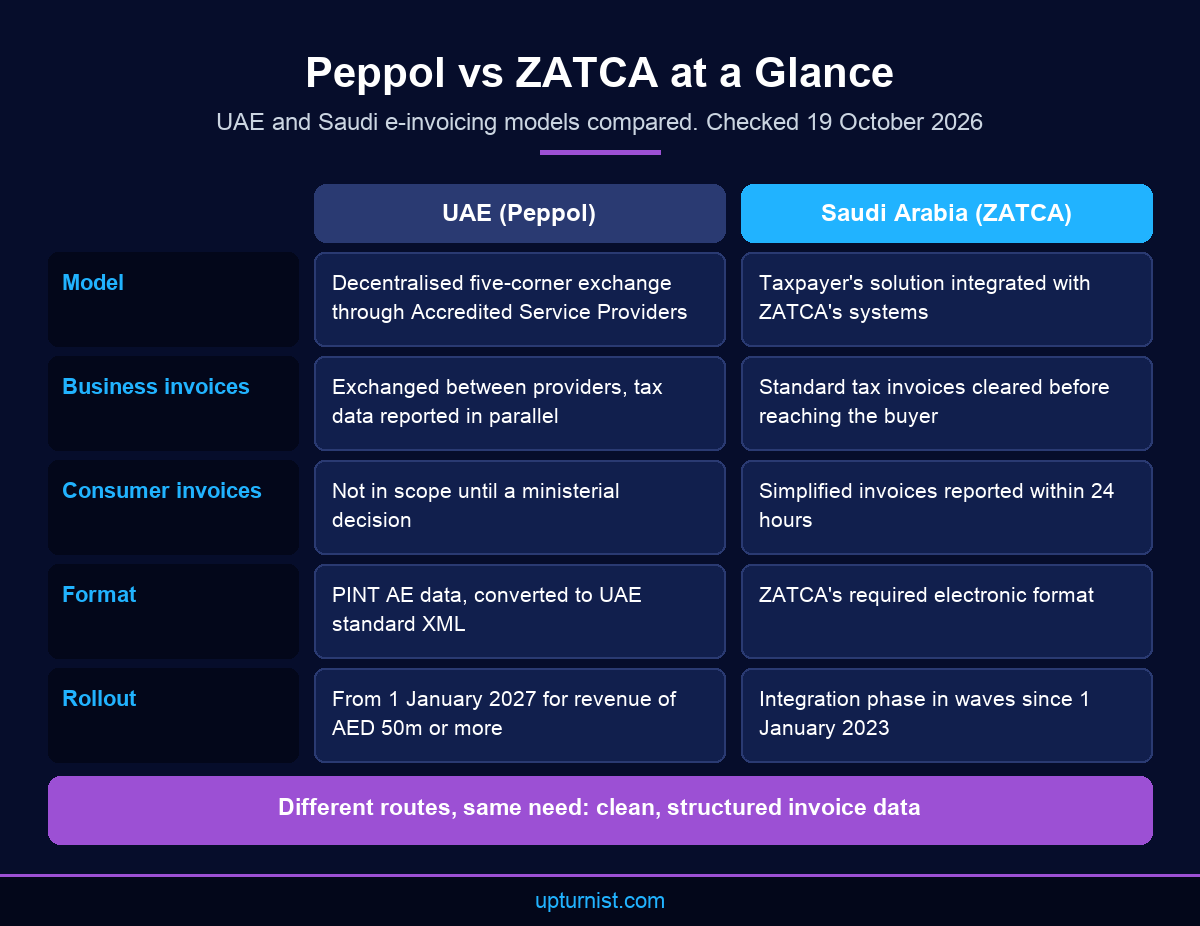
The model is the biggest difference. In the UAE five-corner model, the supplier’s provider exchanges the invoice with
the buyer’s provider and reports a Tax Data Document. In Saudi Arabia, standard tax invoices between businesses are
cleared by ZATCA before they reach the buyer. Simplified invoices to consumers are reported within 24 hours.
Scope also differs. ZATCA’s rules cover both business and consumer invoices. In the UAE, business to consumer
transactions stay outside the system until the Minister issues a decision. Timelines differ too. Saudi waves began in
2023, while UAE phases start on 1 January 2027 for businesses with revenue of AED 50 million or more.
Format is the final difference. UAE invoice data follows the PINT AE specification and is converted into the UAE
standard XML format. ZATCA sets its own required format. Your ERP may need to produce both from the same underlying
data.
Read the comparison as a guide, not legal advice. Both countries continue to update their rules, guidelines and
technical specifications. Before you design anything, confirm the current position with each authority and with your
tax advisers. Then use the differences to decide what your shared ERP must hold and what each country connection must
add.
What Groups Operating in Both Countries Should Plan For
The first task is mapping. List every legal entity, where it is registered and which rules apply. A UAE entity with
revenue of AED 50 million or more must appoint an Accredited Service Provider by 30 October 2026. A Saudi entity
follows its assigned ZATCA wave.
The second task is data. Customer, supplier and item records should follow one standard across the group. Clean shared
data lets each country connector do its job without manual fixes. Inconsistent data doubles the clean up effort,
because each country’s validation will reject it in different ways.
The third task is process. Credit notes, corrections and approvals should follow one group policy, with country rules
added where needed. For example, Decision 243 requires UAE invoices to be issued and transmitted within 14 days of the
transaction date. Saudi clearance happens before the buyer receives the invoice.
The fourth task is people. Finance teams need to know which system handles which entity and how to read status
messages from each. Short, country specific training avoids confusion when the first rejections arrive.
Governance ties these tasks together. Appoint one group owner for e-invoicing and one lead in each country. Hold a
short monthly review of deadlines, open issues and test results. This keeps both projects visible to leadership and
stops one country’s work from being delayed by the other’s.
Choosing E-Invoicing Solutions for UAE and Saudi Operations
Cross-border groups often ask whether one platform can serve both countries. Sometimes it can. More often, the answer
is one ERP with two compliant connections. The right choice depends on your systems, volumes and entity structure.
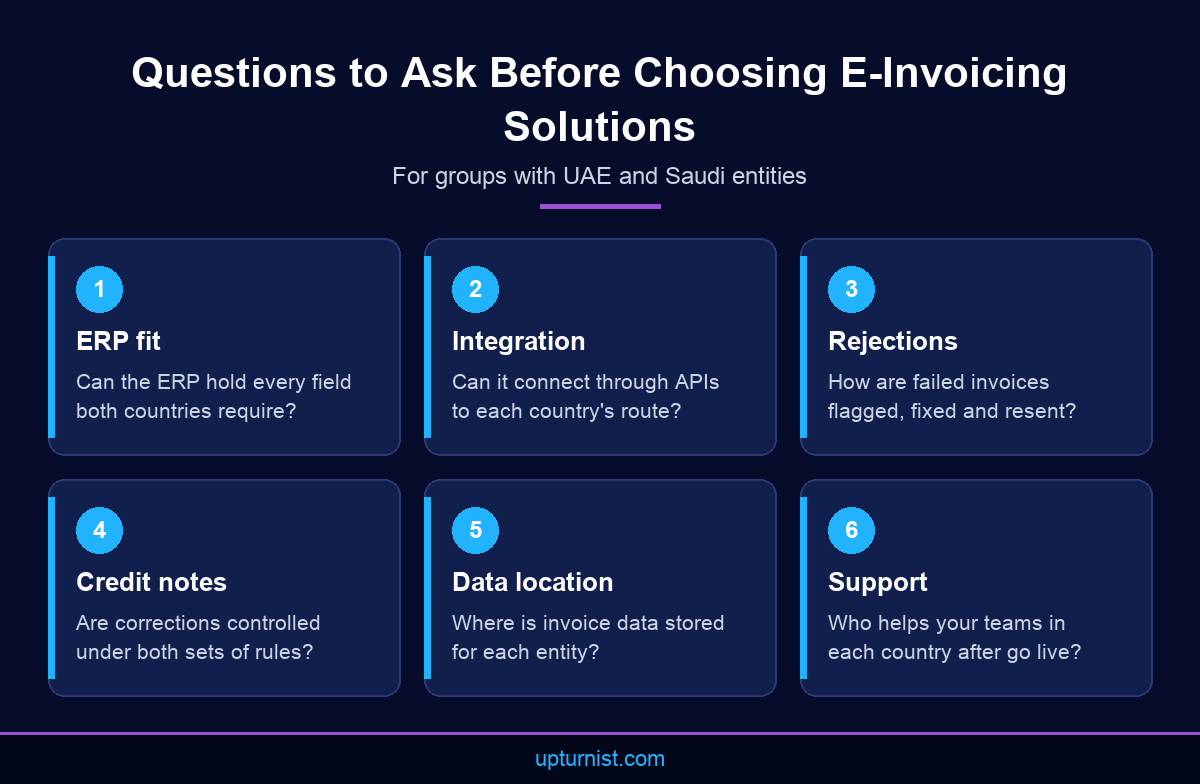
Start with the ERP. Can it hold every data field both countries need, and can it be integrated through APIs? Then look
at the connections. In the UAE, you will need an Accredited Service Provider from the list the Ministry publishes. In
Saudi Arabia, your solution must meet ZATCA’s integration requirements.
Compare e-invoicing solutions on substance. Ask how each handles rejections, credit notes, test environments and
support in both countries. Ask where data is stored, because Decision 243 requires UAE invoice data to be kept within
the UAE. A cheaper option that creates daily manual work is rarely cheaper in the end.
Our technology consulting team helps businesses
evaluate e-invoicing solutions against their own processes, and recommends what fits your business, budget and growth
plans.
Plan for change after go live as well. New entities, acquisitions and system upgrades all affect invoicing. Choose
e-invoicing solutions that can add entities and adapt to rule changes without a full rebuild. Flexibility is worth
more than a long list of features you may never use.
Finally, test both routes with real data. Run a sample of actual invoices through each country connection before go
live. Compare results, fix shared data issues once, and record lessons for the next entity. A short pilot like this
exposes most problems while they are still small.
How Upturnist Supports Cross-Border Readiness
Upturnist works across both models. We have implemented ZATCA Phase 2 compliant solutions in Saudi Arabia, including
an
ERP rollout for a steel manufacturer. In the UAE, our e-invoicing readiness work
helps organisations assess systems, optimise
invoicing processes and prepare ERP platforms for compliance.
For groups, we start with the business rather than the software. We map entities, data and processes, then recommend
the simplest set of e-invoicing solutions that meets both countries’ rules. Always confirm current dates on the
Ministry of Finance eInvoicing portal before you plan.
Our work does not stop at compliance. Connected invoicing often reveals wider gaps in procurement, inventory or
reporting. Where it makes sense, we help close those gaps too, so the investment in e-invoicing solutions improves how
the whole group operates and makes decisions.
Conclusion
Peppol and ZATCA solve the same problem in different ways. The UAE relies on Accredited Service Providers and a
five-corner exchange. Saudi Arabia integrates invoicing systems with ZATCA directly. Groups in both countries need one
clean data foundation, clear group processes and compliant connections for each market. Start with a shared readiness
review. Choose e-invoicing solutions that fit your operations, not just the rules. To plan readiness across both
countries with one team, talk to our consultants today.
Frequently Asked Questions
What is the main difference between Peppol and ZATCA e-invoicing?
The UAE Peppol model exchanges invoices between Accredited Service Providers and reports tax data in parallel. ZATCA
requires the taxpayer’s solution to integrate with its systems, with clearance for standard tax invoices between
businesses.
Can one e-invoicing solution serve both the UAE and Saudi Arabia?
Sometimes. Many groups use one ERP with two compliant connections, one for each country. The right setup depends on
your systems, invoice volumes and entity structure, so assess these carefully before choosing any platform.
Are consumer invoices covered in both countries?
Not yet in the UAE. Business to consumer transactions stay outside the UAE system until a ministerial decision brings
them in. In Saudi Arabia, simplified invoices to consumers are reported to ZATCA within 24 hours.
When does UAE e-invoicing start?
Businesses with revenue of AED 50 million or more must go live by 1 January 2027, after appointing a provider by 30
October 2026. Smaller businesses follow on 1 July 2027 and government entities on 1 October 2027.
When did ZATCA e-invoicing start?
Phase One, the generation phase, was enforced from 4 December 2021. Phase Two, the integration phase, began on 1
January 2023 and is rolled out in waves, with each group of taxpayers given its own deadline.
What data format does the UAE use?
Invoice data follows the PINT AE specification, based on Peppol. The supplier’s Accredited Service Provider validates
it and converts it into the UAE standard XML format if it was received in another format.
What should a cross-border group fix first?
Shared master data. Customer, supplier and item records should follow one group standard. Clean data lets each
country’s connection work without manual fixes, reduces rejections and shortens testing in both markets at the same
time.
Does Upturnist work across many industries?
Yes. Our solutions cover operational excellence, field operations,
manufacturing, enterprise digital transformation and smart infrastructure and IoT. Our nine published case studies
cover projects delivered for clients in the UAE and Saudi Arabia.
How does Upturnist approach a new engagement?
We understand the business first, improve how it works and then implement the right solutions. Our
services page explains each area, from business consulting and business
transformation to digital transformation and technology consulting.